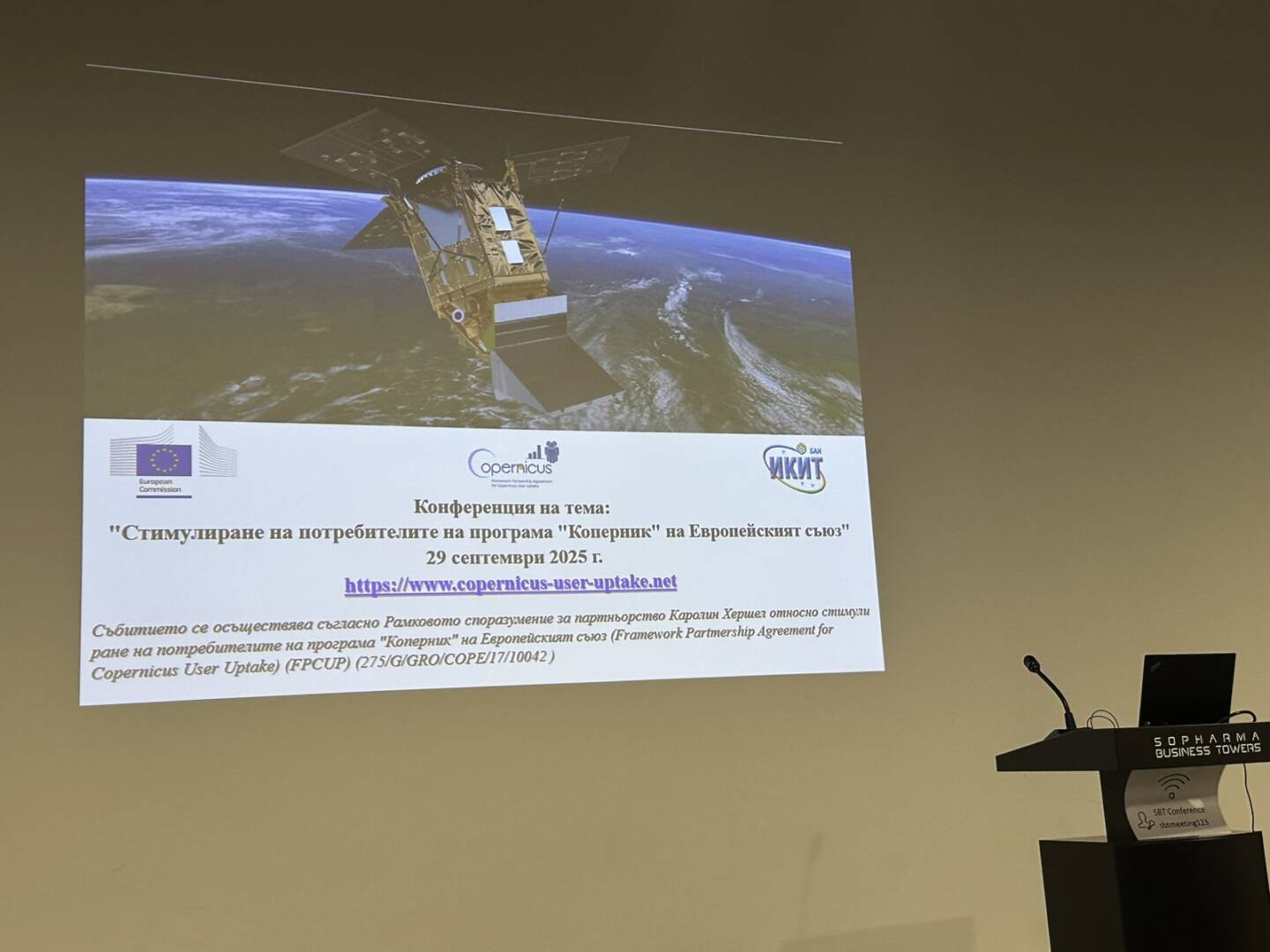
On 29 September 2025, the Final Conference “Promoting the Use of the European Union’s Copernicus Programme” was held in Sofia.
The team of the Space Research and Technology Institute (SRTI) at the Bulgarian Academy of Sciences presented the results achieved from successfully implemented projects under the Copernicus Programme.
As a partner in one of the projects, GAP Consult presented the geoportal developed by our team. The geoportal is built entirely on open-source technologies and can be accessed at the following link: https://home.landscapemetrics.eu/.
For the development of the portal, the GeoNode architecture was selected – a proven secure and reliable platform suitable for regional, national, multinational, and even global projects.
The key advantages of the portal, highlighted during the conference, include:
-
Open-source based – no licensing fees, making it an excellent and sustainable alternative to commercial GIS platforms;
-
Integration with GeoServer – enabling the publication of WMS, WFS, and WCS services for easier access to spatial data;
-
Integration with pyCSW and Django – supporting metadata management, user access, and automated processes;
-
Flexibility and scalability – customization and extension through Python and Django;
-
Support for multiple data formats – shapefile, GeoJSON, KML, TIFF, CSV, and others;
-
Interactive maps, story maps, and dashboards – for creating and sharing interactive visualizations.
During the event, colleagues from SRTI–BAS also conducted a live demo, demonstrating the capabilities of the system, including loaded and analyzed datasets, search functionalities, service sharing, and integration features (for example, with the Italian Institute for Environmental Protection and Research – ISPRA).
The event concluded in a festive atmosphere with a specially prepared cake, kindly provided by the organizers.
We at GAP Consult are proud and delighted to have had the opportunity to partner with the team of SRTI–BAS on one of the implemented projects. All participants expressed a shared hope that these good initiatives and successful examples will continue and be further developed in the future.